How the work moved through the studio
Two patterns cover the roster. They produce the same credit split downstream, the studio's craft credit on every deliverable it built, and they differ in who opened the door.
| Pattern | How it starts | What I do | What the studio does |
|---|---|---|---|
| I source, the studio builds | I already had the relationship or the concept | Bring it in, set the direction and the narrative, price the engagement, hold the client | Design and production, once the direction is set |
| The studio sources, I advise | The studio already had the concept or the relationship | A defined function the studio does not run in-house: capital, go-to-market, or cost | The concept and the craft; it owns them |
The engagements, in the order the decisions were made:
- Plunge Studio: the pattern in reverse, and the origin. Known: the studio's concept, pitched to me as an investment. The question was what it would take to make it fundable, not whether to fund it. It produced an advisory scope, capital raise strategy, go-to-market and construction cost, and it produced the partnership. Plunge Studio is still a concept in development. It has never been described here as a delivered engagement or a raised round, and it will not be until it is.
- Drive for the Dream: my concept, and the platform the rest moved through. Known: a golf docuseries venture I built, with Jasper Sports Management formed as the representation arm. The studio came in afterward to run the branding, not as the originator. The question was whether one athlete platform could carry more than one kind of brand engagement, and the answer was the architecture: a parent brand for the management company, and under it, athlete identities and a product brand. That report is its own file; here it is the door the next three came through.
- Jasper Brands: a product brand that goes with the show. Known: the platform now existed, and an investor in Drive for the Dream wanted a clothing line to supplement the show. The question was what a product looked like beside it, and the studio built a golf polo brand, positioned around the golfer who does the work, with the deck's whole case built on what a polo gets wrong and what this one fixes. The brand goes with the show: a sub-agreement within it, a spinoff that is part of the show package. Samples were made, but it was not produced and has not gone to market yet. It is on the roster as evidence the architecture carries more than one kind of engagement.
- Luke Kwon: a personal brand for a golf creator changing his representation. Known: Kwon was leaving his group and looking for different representation and different sponsorships, and the relationship came through Drive for the Dream. The question was how to position a creator, not a tour player, in a sport whose heroes had always been untouchable, and the deck's answer was accessibility: the face of golf has changed, and this generation wants to know the person. The studio built it; I set the direction and brought the relationship. Kwon went on to win the inaugural PGA Tour Creator Classic in August 2024. That is his own result, and I claim no part of it for the deck.
- Vincent Hancock: an Olympic champion's brand identity, after the 2024 Games. Known: the window after a Games is when a champion's attention is worth the most and when nobody has yet decided what it is for. The question was what the brand had to do, and the answer was sponsor-facing, not fan-facing: a deck a corporate audience could book from, that led with what the audience needed and held the medals until the reader was already leaning in, subtracting until what was left was the thing itself. The studio built it, we went back and forth, I set the direction and the narrative. Attachment A describes the package and its architecture.
- Fluidmapper: a Common Ground client brought to the studio's craft. Known: a deep-tech measurement company whose technology its owner could not sell. I brought the client; Common Ground's studio built the brand strategy and a conversion architecture that cut four funnel pages to one process-led page. It is on this roster because it is the same pattern as the athletes: I hold the client and the narrative, the studio builds. The engagement itself is its own report.
My argument was that the units were going to get a lot cheaper, and it just wasn't cost-effective to do a high-end studio, which was true.
What the seat produced
The roster below is the record of the seat: what each engagement was, who opened the door, who built it, what exists, and where it stands. The figure under it is the same roster on a calendar, drawn from the dates on the decks themselves.
<div style="page-break-inside: avoid;">
| Engagement | Who opened the door | Who built it | What exists | Status |
|---|---|---|---|---|
| Plunge Studio | The studio | The studio; I advise on capital, go-to-market and construction cost | Concept and brand in development | In development |
| Drive for the Dream | Me | The studio, on the branding, after the concept existed | The brand, the sponsor collateral, the Jasper Sports Management architecture | Active |
| Jasper Brands | Me, through the architecture | The studio | A 25-page golf polo brand deck, September 2023; the brand is part of the show package | Samples made; not produced; not yet taken to market |
| Luke Kwon | Me, through Drive for the Dream | The studio; I set direction and narrative | A 20-page personal brand strategy deck, April 2024 | Delivered; the relationship is closed |
| Vincent Hancock | Me | The studio; I set direction and narrative | A 23-page brand identity deck, October 2024 | Delivered |
| Fluidmapper | Me, as a Common Ground client | Common Ground's studio | Brand strategy and a conversion architecture, 2026 | Delivered |
</div>
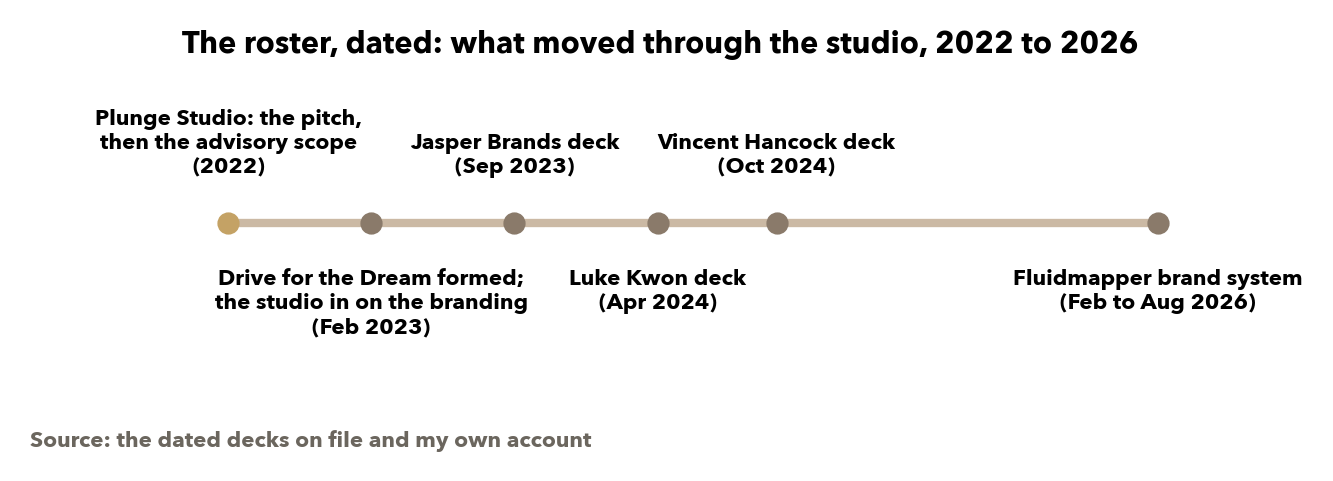
Two things to take from the shape. Most of the roster runs one direction, my relationships and concepts into the studio's craft, and the one that runs the other way is the one that started everything. And three finished decks exist and can be read, which is a different kind of evidence from a claim; Attachment A describes one of them.
And one thing that changed at the end. Lip Loi Creative now sits inside the Common Ground portfolio. I still hold the fractional CRO seat and run its go-to-market strategy, now under the Common Ground umbrella; I bring it clients as part of my own work product, and the studio builds. Many of these engagements want more than one person in the seat, which is why I built the Common Ground team of operators to work these seats together. That was not the plan in 2022. Most of my relationships started as an engagement and evolved into a working partnership, and this one did too. The great partnerships evolve into long-term things.
What we kept, and the two things we installed
We kept everything that was already good, which was the craft and the method. The studio runs a two-phase method of its own, Market Reality then Fundability: pressure-test the idea against real buyers before any story or design work, then turn what survives into something an investor can understand and fund. The method is the studio's, it predates the seat, and nothing about it needed to change.
What the studio did not have was anyone who owned revenue, and that is what the seat installed. In practice the fractional CRO here does four things, month to month, none of them a sales call: sources the engagement, sets its position and narrative, prices it, and holds the client so the studio can build. Attachment B is that seat written out, with who decides what.
The second thing installed was a rule, and it came from the first conversation.
Fix it before you fund it
The three questions I put to a concept before anyone talks about money, in this order. The pitch answers none of them, which is why they have to be asked.
| Question | Why it comes first | What it caught on Plunge Studio |
|---|---|---|
| What does it cost to build, priced by someone who has carried a build | A concept is complete as an idea long before it is complete as a cost; the pitch shows the idea | A high-end build earned back against a margin that was shrinking during construction |
| Where is the cost curve of the core equipment going | If the customer can soon own the thing at home, the premium for access falls with the price | The units were getting a lot cheaper, and the studio's whole premium sat on them |
| What is the go-to-market before the capital ask | Money raised without a route to the first hundred customers is money spent finding one | The capital raise strategy and the go-to-market were scoped together, not in sequence |
The logic that had to change: a funding pitch treats "is this good" and "is this ready" as one question. They are two. Answer the second one first, and most of the time the answer is a scope of work, not a check.
The rule now runs the other way as well. When I am brought into someone else's concept rather than my own, the default scope is advisory, capital strategy, go-to-market, and the cost and delivery side. Not funding. That is the shape of the Plunge Studio engagement today and it is the shape I would offer any creator who pitched me tomorrow.
What it cost to hold the line, and what I would watch
Answering a pitch with a structural read instead of a yes costs something in the moment. It can land as a pass. There was no guarantee the studio would come back with a narrower ask instead of walking away, and I was trading the simplest version of the relationship, a clean answer to a funding question, for a harder one, an advisory scope that only pays off if the thing actually gets built. This time it became a partnership and then a studio under the Common Ground umbrella. Nothing about that was guaranteed.
Holding the pricing away from the craft side has a cost too. It means the studio has to trust a number it did not set on work only it can make, and it means I have to be right about what a buyer will pay for craft I did not produce. And sourcing most of the roster myself means the pipeline is my relationships, which is a strength on the engagements above and a limit on how fast the studio can grow past them.
What I would watch, in this studio or in any creative business where the owner is the product:
- The pricing seat. The creator should never be the one to price. The moment the person making the thing is also the person setting the number, the number drifts toward what feels fair to make rather than what the buyer will pay.
- The direction of the door. Count which way the work comes in. If it all comes through one person's relationships, the studio has a pipeline that retires when that person does.
- The narrative on every engagement. Who this brand is for, why at this price, and what it has to do for the client. If nobody owns that sentence, the deck will be beautiful and the client will not know what to do with it.
- Readiness before money. Every concept that walks in as a funding ask gets the three questions first. Most of them leave with a scope of work instead, and that is the better outcome for both sides.
- The credit line. A client will not always want the studio's name on its brand. The studio's name is often absent from a deliverable by design, and that is never evidence the studio did not build it.
What it produced
Six engagements on the roster, five of them opened by me, four delivered as finished brand work: an Olympic champion's identity, a golf creator's personal brand, a golf polo brand built as part of the Drive for the Dream show package, and a deep tech client's brand system. Lip Loi Creative now sits inside the Common Ground portfolio. I still hold the fractional CRO seat and run its go to market strategy, now under the Common Ground umbrella; I bring it clients as part of my own work product, and the studio builds.
A slice of the project list
A few related projects.
- Drive for the Dream: a golf docuseries venture and the Jasper Sports Management platform the roster ran through (February 2023 to November 2025)
- Fluidmapper: a Common Ground client brought to the studio for its brand strategy and site (February 2026 to present)
- Aycre Capital: fund formation and capital raise process as Managing Director (October 2022 to December 2023)
- Xtrata Consulting Seat: another fractional advisory seat, inside a general contractor (2025 to present)